


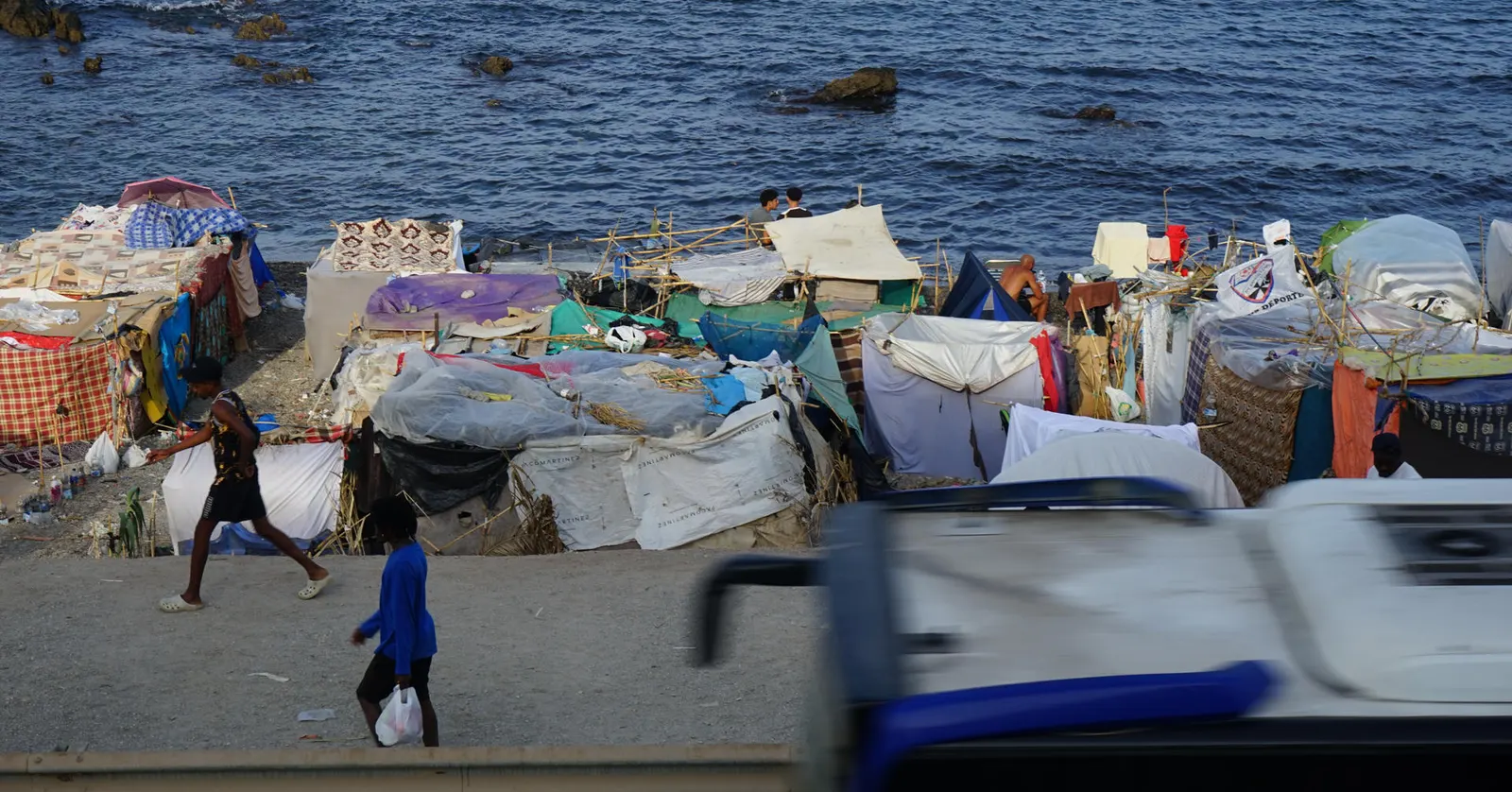
The autonomous city of Ceuta is going through the second month of the migration crisis with a new police eviction that has marked the beginning of an unprecedented judicial phase in the recent history of the city. The National Police completed this Tuesday the clearing operation at Benítez beach, where some still remained 400 persones in makeshift settlements near the city's desalination plant. The operation, which involved around a hundred riot police, left moments of tension with several migrants who tried to break through the police cordon to head towards the city center, and one of them who threw himself into the sea to avoid being transferred, reflecting the desperation of individuals who have lost everything in their attempt to reach European territory.
The situation has become more complicated following the resignation of the Government delegate, Miguel Angel Perez Triano, just one day before the fires of July 30 and 31, which are now the subject of a judicial outline. The resignation, which shook the institutions, has opened a power vacuum in the midst of managing a crisis that demands immediate and coordinated responses between the different administrations. The judge María Tardón, who formalized the investigation two weeks ago, has begun taking statements from the first witnesses with the summoning of the president of Ceuta, Juan Jesus Vivas, for Wednesday, and on Thursday of the former chief of staff of the Government Delegation, Gonzalo Sanz, who received a warning from the National Intelligence Center.
The judicial investigation and the new charges
The investigation, prompted by a lawsuit filed by Iustitia Europa and with the approval of the Prosecutor's Office, has taken a significant turn with the addition of a new offense against the independence of the State. This accusation marks a before and after in the way the crisis is understood, which is now not only questioned from the perspective of police management but is also moving into delicate judicial territory where possible collusion or negligence in the international arena is sought to be clarified. The magistrate pointed directly to «a clear and unquestionable facilitating management by the Kingdom of Morocco» as a determining factor in the mass entry of migrants, an assertion that, if proven, will have geopolitical consequences of great magnitude.
To clarify the facts, the judge has ordered an extensive list of proceedings including the analysis of satellite images, biometric studies, and the tracking of calls spread through social networks. These technological measures aim to reconstruct the events with chronological precision and identify responsibilities in an operation that has left between 2,500 and 3,000 people according to estimates by the Minister of Territorial Policy, Angel Victor Torres, who acknowledges the difficulties in establishing an exact figure in a scenario of such complexity. The use of satellite imagery represents an innovative approach to document the movements of people and possibly identify external coordination in the mass entry.
The humanitarian dimension and institutional responses
While justice opens its proceedings, the humanitarian situation remains a huge challenge for the authorities. A group of migrant minors has once again demonstrated at Trampolí beach demanding protection and specific reception centers, addressing the President of the Government directly, Pedro Sánchez, in an act of protest that highlights the extreme vulnerability of the youngest in this crisis. The authorities have justified the eviction on safety grounds, arguing the presence of a dam spillway and the arrival of the rainy season, circumstances that add additional risk for the people settled in the area.
According to police sources, more than 200 people have opted to return voluntarily to Morocco without being identified or requesting international protection, a figure that highlights the fear or mistrust of the migrant group towards the reception procedure. The Police escorted the buses that transferred them to the Tarajal border in operations that generated tension among those affected. Other migrants agreed to go to the Temporary Assistance Center for Foreigners (CATE), where it was expected to identify between 300 and 400 people before referring them to the reception facility in Loma Colmenar. Since August, a total of 8,243 people have returned to Morocco and 213 minors have been transferred to the Peninsula, data that reflect the escalation of the crisis and the inability of the current system to manage the influx.
The Ceuta crisis reflects the fractures of a saturated reception system and the impossibility of absorbing migratory flows of this magnitude in such a limited space as an autonomous city. The situation is framed within a broader international context where crises of sovereignty and border management test institutional cohesion, as has been seen in other scenarios of conflict and geopolitical rearrangement that redefine the world order, such as in the article The UN in terms of wars, crises and new alliances, where it is analyzed how global crises are transforming international alliances.
The judicial process progresses with the summoning of more witnesses and the preparation of technical reports that could determine the political and administrative responsibilities in an operation that has highlighted the deficiencies of the system. The eviction of Benítez beach, with its images of tension and despair, recalls other controversial operations such as The Eviction of Maricarmen, chronicle of a social tragedy in the heart of Madrid, where forced evictions have generated debate on the limits between security and fundamental rights.
While migrants continue to accumulate in precarious spaces and minors demand urgent protection, Ceuta becomes the reflection of a Europe confronted with the limits of its immigration and human rights policies. The judicial investigation, with the possible inclusion of crimes against the independence of the State, opens a door that could radically transform the way of understanding and managing migratory crises in the border states of the European Union, setting a precedent that could be closely observed by other countries in similar situations.

