


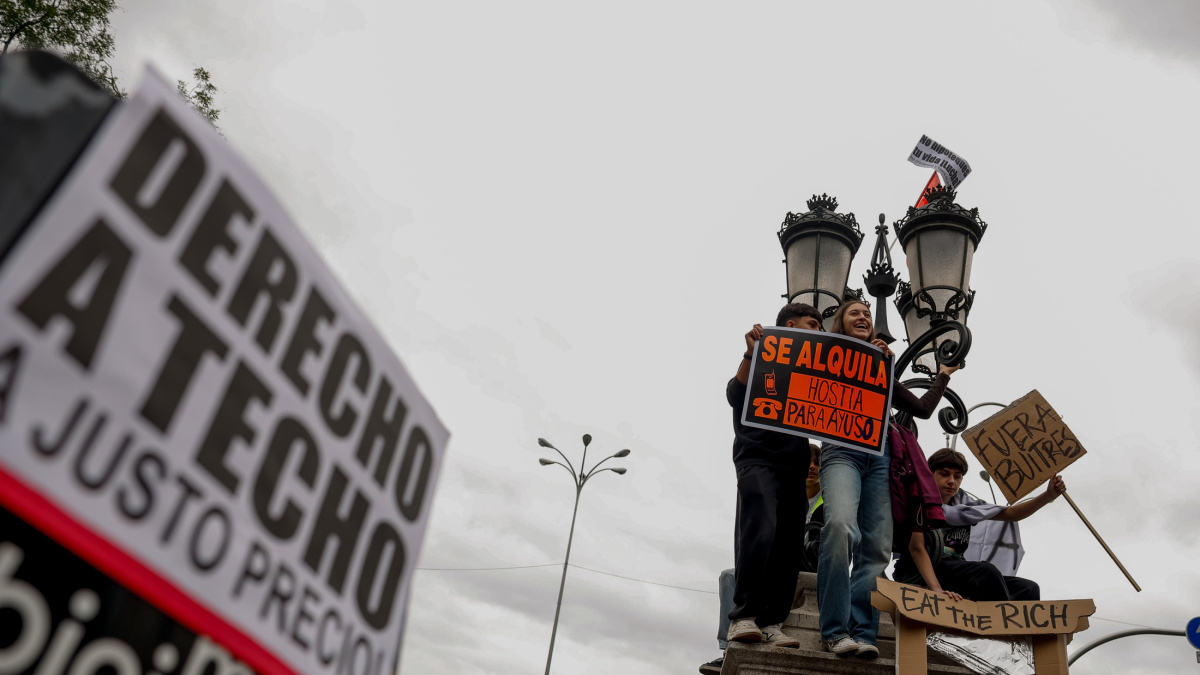
The Spanish State has become the scene of a wave of massive and coordinated protests, with the housing crisis as the epicenter of growing social discontent. Tens of thousands of people filled the streets of more than 30 cities last Saturday, and the mobilizations have continued with strength this Sunday, highlighting the urgent demand for solutions to speculation and unaffordable prices. From the Puerta del Sol a Madrid to the squares of València, Màlaga o Palma, citizens are raising their voices, and with them, tensions are also rising, with incidents that have required police intervention and arrests in various parts of the Spanish geography. The situation reflects a society that, tired of residential insecurity, demands structural and immediate changes, while the political debate intensifies around the management of this issue.
Escalation of Tensions in the Heart of the Capital and Other Hotspots
Saturday night was particularly tense in the Puerta del Sol de Madrid, where a housing protest camp has taken over from the daytime demonstrations. In an incident that highlights social polarization, three far-right individuals were arrested by the Police in the vicinity of the square as they tried to access the site. From inside the camp, activists responded with the now-iconic cry of «No pasarán», a historical echo of resistance that is now applied to defending the right to decent housing. This confrontation was not an isolated event, as in Sevilla, la Police had to charge against anti-fascist protesters who sought to prevent a far-right rally, highlighting the growing friction in public space.
Saturday was also marked by significant altercations in València. At the end of the demonstration for the right to housing, five people were arrested for clashes with the Police. The detainees are accused of throwing fences, cobblestones, and pyrotechnic devices at officers of the Police Intervention Units guarding the Palau de les Arts. The protesters' goal was to block access to the venue, where a real estate investment congress was being held at the time, a symbol of the criticism of speculation fueling the crisis. These five detainees will appear in court this Monday, while the Valencian city recovers from a day of tension that highlights the depth of the conflict. The call for housing resounds strongly across the State, from Sol to the Canary Islands, in a crisis that seems to be in full boil, as can be explored further in La Crida per l’Habitatge Resona a l’Estat: De Sol a les Canàries, una Crisi en Ebullició.
The Movement Expands: From the Canaries to the Call for a General Strike
The mobilization for housing is not limited to the mainland. In the Canary Islands, el Tenerife Tenants Union has announced that it will take «a step aside» regarding the camp set up in the Plaza de España de Santa Cruz, although the camp participants intend to remain there for a period yet to be defined. David González, island spokesperson for Tenerife Tenants, has confirmed that an assembly is scheduled for 5:00 p.m. this Sunday to decide on the next steps, stressing that «more and more people want or are interested in joining» this protest action. This dynamic demonstrates the adaptability and willingness for continuity of the movement, which seeks to consolidate and expand its reach.
This Sunday, cities like Bilbao, Oviedo, Almería, Badajoz, Salamanca i Cuenca have taken up the baton of the massive demonstrations by the Tenants Union, demanding stronger measures in the face of the housing crisis and against speculation. In Salamanca, about 2,000 people, according to police estimates, took part in the march, displaying banners with slogans such as «O los bajáis o los bajamos», «Contra el negocio de la vivienda» and «Nuestro techo, su negocio». Chants directly addressing the Prime Minister were also heard, such as «Pedro Sánchez, rentist accomplice. PSOE and Sumar, accomplices», highlighting frustration with current policies. These new mobilizations join those already confirmed for Sunday afternoon in Logroño, Múrcia, Teruel, Còrdova i Ourense, with another call scheduled for Monday a Pontevedra a les 8:00 p.m., according to the latest update of the Confederation of Tenants' Unions. They all demand indefinite contracts and lower prices, and the movement is already considering the possibility of a general strike as a next step, raising the bar of their pressure. In this context, the defeat of certain housing decrees in Congress and their political connections reveal the complexity of the legislative landscape, as analyzed in La derrota dels decretos de vivenda al Congrés i les connexions polítiques que es desprenen.
The political response was not long in coming. The deputy general secretary of the PP, Miguel Tellado, has taken the opportunity to lash out at the President of the Government, Pedro Sánchez. In a video sent to the media, Tellado has declared that Sánchez «remains lying on the Moncloa couch» ordering «polls in a hurry», and has demanded that he not think twice and «press the button» to call general elections now. According to Tellado, Sánchez would have commissioned these polls from the president of the CIS, Félix Tezanos, while weighing whether to «call elections now or leave it for a few months». «Pedro, don't think twice, do it! Call general elections tomorrow. Press the button. Let's start the campaign and in less than two months we will see what the citizens think,» cried the popular representative, injecting the housing crisis into the already hot arena of electoral politics.
This wave of massive housing protests, which has shaken the Spanish State from north to south, underlines a deep social dissatisfaction with current policies and the economic situation. The tense incidents in Madrid i València, along with the continuity of mobilizations in numerous cities, show that the right to decent housing has become a central and unavoidable issue on the political and social agenda. Citizen pressure, articulated through tenants' unions and social platforms, not only demands immediate measures to curb speculation and guarantee fair prices, but also threatens larger-scale actions, such as the possible calling of a general strike. In the short term, local assemblies and coordination between movements are expected to mark the next steps, keeping the tension on the streets and in public debate. In the long term, this crisis could redefine political priorities, forcing governments to adopt more structural solutions and rethink the model of access to housing, with significant implications for urban planning legislation, rental market regulation, and the very social cohesion of the State.

