


La ciutat autònoma de Ceuta experienced a day of deep tension this Sunday, marked by multiple citizen mobilizations that reflected the latent unease and uncertainty running through the region since the massive entry of migrants at the end of July. More than a thousand residents took to the streets, called by the Federation of Neighborhood Associations, to express a strong rejection of the management of the crisis by the Govern central i de Morocco. The events culminated in altercations at the port, highlighting the growing polarization and complexity of a situation that transcends the migratory sphere to permeate every area of life in Ceuta.
The day consolidated a pattern of protest that has been manifesting for weeks, with citizens demanding answers and solutions in the face of an immediate future perceived as uncertain. The crisis, which initially focused on the arrival of a large number of people, has evolved into a scenario of deep social and political division, where demands for security and stability are mixed with concern for the image and functionality of the city. This complex context is aggravated by the feeling of abandonment and constant pressure on public services and local infrastructure.
Citizen mobilizations: From Tarajal to collective rejection
The morning was dominated by a citizen march that gathered more than a thousand people, who marched nearly two kilometers along the Ceuta coastline to the border of Tarajal. Under the persistent slogan of «A caballa never gives up» and led by a banner with the explicit message «SOS Ceuta invaded», the demonstration was a clear expression of popular discontent. Protesters chanted slogans directed at both the Spanish government and the Moroccan authorities, to whom they attribute part of the responsibility for the current crisis. The protest concluded in front of the border, under the close watch of police forces, reaffirming the determination of a significant part of the population to make their voices heard.
Added to this neighborhood mobilization was a gathering of motorcyclists who, starting from Passeig Alcalde Sánchez Prados, also converged at the border. This initiative included a tribute to the Legion on the occasion of its 106th anniversary, linking the sense of belonging and territorial claim with support for the armed forces. The event highlighted the role of the military institution in the perception of security and identity of the city.
Within the framework of these mobilizations, retired colonel Carlos Pavón took the opportunity to denounce the poor conditions in which the military deployed in the city operate, pointing out that these troops work without the necessary means. This statement added a new layer to the widespread criticism of the management of resources and the protection of security and defense forces in a context of prolonged crisis.
These Sunday protests were not isolated events, but the continuation of a series of demands that began with a rally on Saturday in front of the Government Delegation, a la Plaça dels Reis. There, a neighborhood camp-in persists with the aim of making visible the situation of Ceuta's beaches and the need for urgent intervention to restore normalcy and healthiness to the environment. The complex management of the migration crisis in Ceuta has generated a political and judicial labyrinth, as analyzed in depth in previous articles.
Altercations at the port and the debate on humanitarian aid
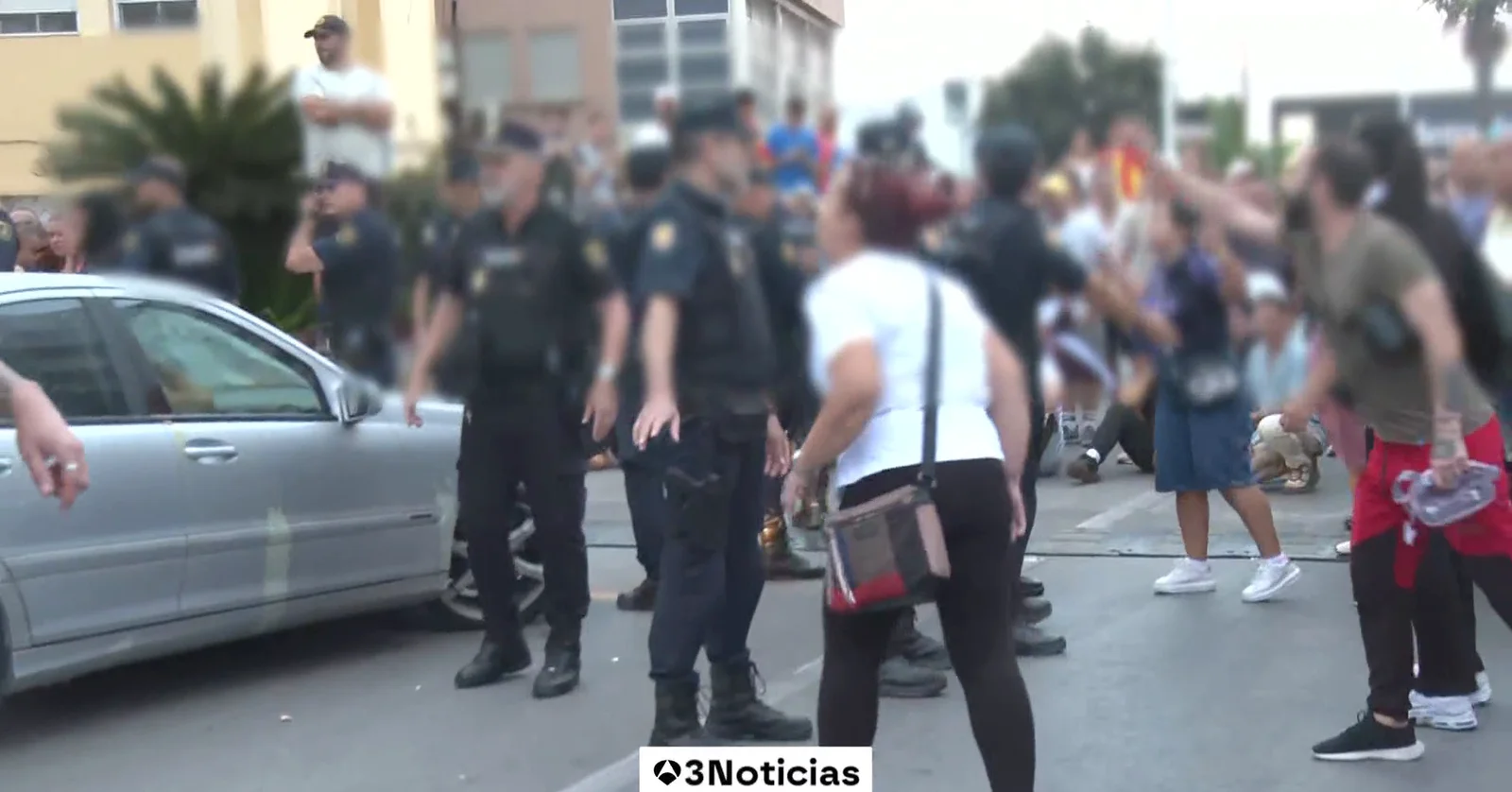
The morning's calm was shattered in the afternoon with the outbreak of altercations at the port, coinciding with the arrival of members of the collective Negu Gorriak/Derecho a Techo. Dozens of people, called through social networks, gathered to express their rejection of this group, which they link to the radical left. This counter-protest highlighted the ideological division and social polarization that has emerged strongly in the city.
El col·lectiu Negu Gorriak/Derecho a Techo had previously announced that the purpose of their trip was to provide humanitarian aid, perform emergency tasks, and carry out observation work in the face of possible attacks against refugees. However, their presence was interpreted by a sector of the citizenry as a provocation, triggering a direct confrontation.
During the incidents, some of those present threw stones at least at one vehicle, which had to leave the scene escorted by the Policia Nacional. A young man was detained and taken to police facilities to complete his identification. Units of the Policia Nacional, including units of the UIP (Police Intervention Units), had to remain in the area to control the situation and prevent a major escalation of violence. At least one person was transferred in a police vehicle after the altercations, confirming the severity of the clashes and the need for intervention by law enforcement. The city of Ceuta is under constant pressure, with arrests for occupation and a deployment of accommodation reflecting the complex management of the migration crisis, as detailed in this article about Ceuta under Pressure.
In an attempt to convey a message of normality and confidence amidst this complex panorama, the University of Granada has released a video prior to the return to classrooms at the campus of Ceuta, scheduled for September 22. In the video, members of the faculty, staff, and students encourage the university community to return to the city, with statements such as «Returning to class is not just an academic gesture, it is an act of trust and community.» This initiative seeks to project an image of resilience and commitment to the city's future, despite the social and political tensions running through it.
Finally, from the national political level, the President of the Government and Secretary General of the PSOE, Pedro Sánchez, took advantage of the Festa de la Rosa of the PSC a Gavà (Barcelona) per acusar el PP i Vox de respondre a cada nova crisi amb «una nova deslleialtat» i d’actuar sota la premissa que «com pitjor li vagi a Espanya, millor per als seus interessos polítics». Sánchez va reiterar el seu compromís de destinar tots els recursos necessaris per retornar la normalitat a Ceuta, situant la crisi de la ciutat autònoma en el discurs polític nacional i subratllant la polarització existent entre les principals forces polítiques respecte a la gestió d’aquest tipus d’emergències. La intervenció del president subratlla la dimensió política de la crisi, que ha estat objecte d’una investigació per part de l’Audiència Nacional enmig d’una crisi persistent.
<?php echo esctextarea(getoption(\’nautopromptconclusion\’, \’\’)) ?>

