


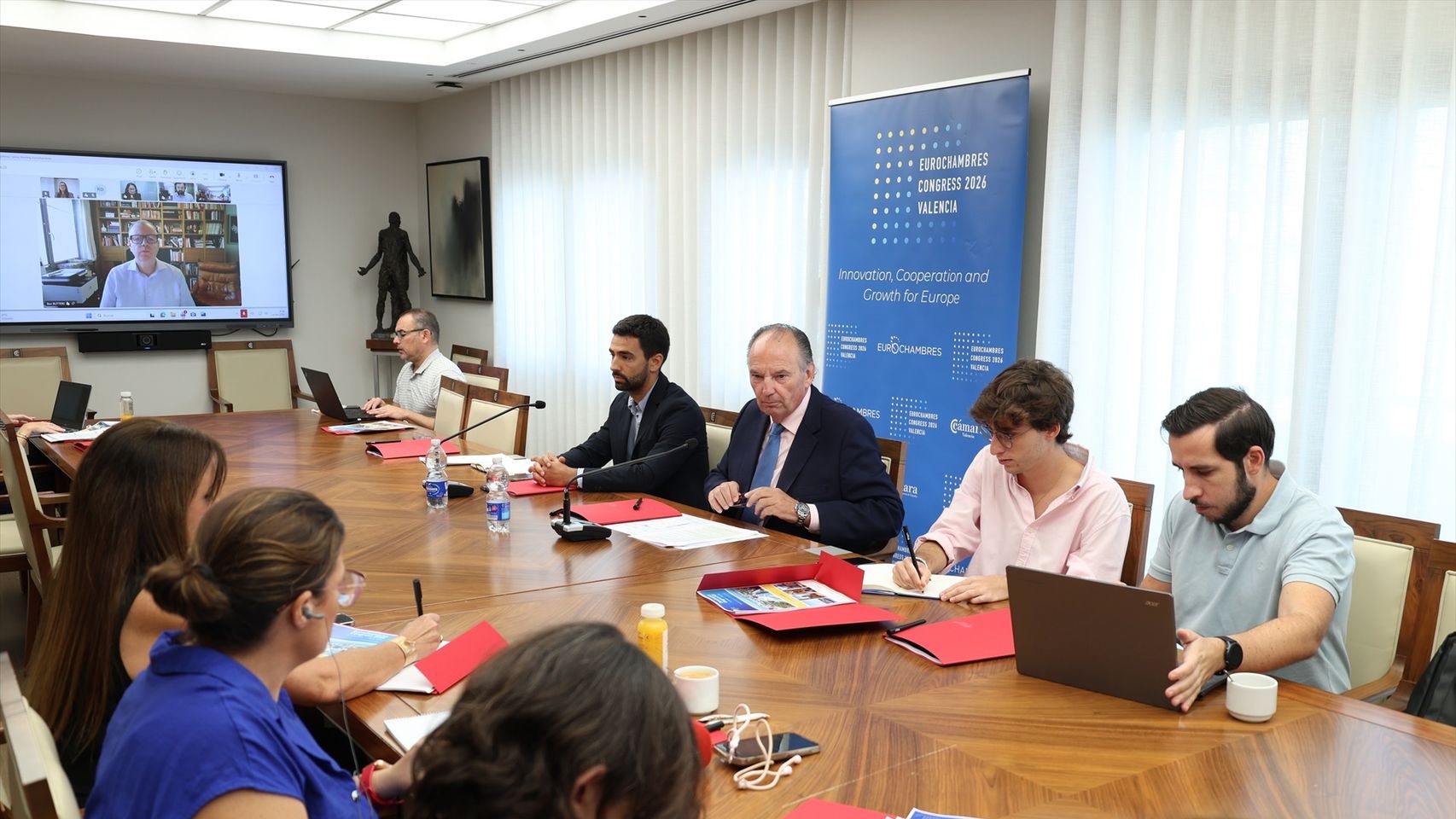
Next week, the capital of the Turia becomes the epicentre of the continental economic debate with the celebration, for the first time in the Spanish State, of the Eurochambres Congress 2026. El Palau de la Música will host on 28 and 29 September a biennial event that will bring together representatives from 91 chambers of commerce from 38 countries, shaping an unprecedented forum to diagnose the health of the European economy and prescribe the necessary remedies in the face of a geopolitical and technological environment that is evolving at a speed that, according to the organizers themselves, the Old Continent is failing to match. The choice of Valencia is no coincidence: it reflects the desire to highlight a territory that, despite recent adversities, exhibits positive investment dynamics, a solid export tradition and a key port infrastructure for global trade.
The challenge of the Single Market: Europe's great unfinished business
The common thread of the sessions will revolve around an uncomfortable truth that the vice-president of Eurocàmbres and president of Valencia Chamber of Commerce, José Vicente Morata, has put on the table without beating around the bush: Europe urgently needs to regain productivity, industrial capacity and competitiveness Morata warned that, while the world is changing at «an enormous speed», the European response remains stagnant, threatening the foundation of social welfare. Along these lines, the CEO of Eurochambres, Ben Butters, has toughened his tone compared to the previous edition in’Antwerp (2024), assuring that the situation for the economic community «has become even more difficult» and that the chambers must debate how to provide real support to businesses in a «challenging» environment.
One of the most anticipated sessions will be the lecture by the former Italian Prime Minister Enrico Letta, author of the report on the future of the Single Market, under the title ‘Strengthening competitiveness through the Single Market’. Both Morata and Butters agreed in pointing to this space as the «great opportunity» to combat crises and gain speed. Morata was emphatic: «The United States has a large market, but Europe has an even larger one, but with infinite obstacles that hinder the speed of growth». Regulatory and administrative fragmentation prevents European companies from gaining the scale needed to compete globally. Butters added a fierce criticism of member states: «they frequently speak very positively of the single market, but when they get home they do not implement it». The paradox is scandalous: there are companies that find it easier to export to a third market than to a European neighbor. For this reason, the chambers demand that the European Commission assume its responsibility to ensure that states «do their homework» and eliminate the internal barriers that drag down joint economic strength. This inability to act as a single bloc contrasts with external pressure, as evidenced by studies on Spanish exports to the US under the shadow of Trump's tariffs, where internal fragmentation weakens negotiation capacity and external resilience.
Electrification and Artificial Intelligence: the pillars of the new competitiveness
Beyond the regulatory framework, the congress will address the technological vectors that must propel the next decade. The executive president of’Iberdrola, Ignacio Sánchez Galán, will star in the plenary session ‘Electrification: the key to Europe's competitiveness and security’. The goal, according to Butters, is to examine how to electrify the economy by generating opportunities for companies instead of adding complexity and costs, recognizing that Spain is a pioneer in sustainable energy. At the same time, AI Intel·ligència Artificial (IA) will be the focus of a round table with the Director of European Affairs of’Adigital, Raquel Jorge Ricart, and the research director of the’Institute for Economic and Enterprise Research, Endre Molnár. The debate will revolve around the impact of AI on the economy and the services of the chambers themselves, a technology described as a «massive opportunity» but one that brings significant «challenges and complexities», from ethics to the need for highly qualified human capital.
Precisely, the identification of talent and the appropriate skills to implement these innovations will be the subject of a specific session, linking vocational training with the real needs of the productive fabric. In a context where the Spanish trade deficit shows signs of structural stress, as reflected by the increase of 5% until July driven by energy products, the transition towards an electrified and digitalized model is not an aesthetic option, but a matter of economic survival. The ability to attract and retain technological talent will determine whether European companies — and Spanish ones in particular — can take advantage of the AI revolution or if, on the contrary, they will see the gap widen with major global competitors.
Geopolitics and the urgency of a strategic Europe
Les conversations no obviaran l’entorn geopolític, analitzat des de la perspectiva de les càmeres de comerç com a actors claus de la diplomàcia econòmica. La inestabilitat internacional, les tensions comercials i la reconfiguració de les cadenes de subministrament globalitzen l’exigència d’una Europa més forta, més unitària i més ràpida. La celebració d’aquest congrés a València posa la ciutat i la Comunitat Valenciana «en el focus» internacional, tal com va subratllar Morata, en un moment on les notícies sobre inversió són positives i el port exerceix una influència decisiva en el comerç mundial. La conclusió implícita del fòrum és clara: sense un Mercat Únic realment integrat, sense una estratègia energètica coherent i sense una adopció massiva i responsable de la IA, Europa arrisca a convertir-se en un museu a obert del segle XX. El mandat que surti del Palau de la Música haurà de ser, per força, un crida a l’acció immediata per als governs nacionals i les institucions comunitàries.

