


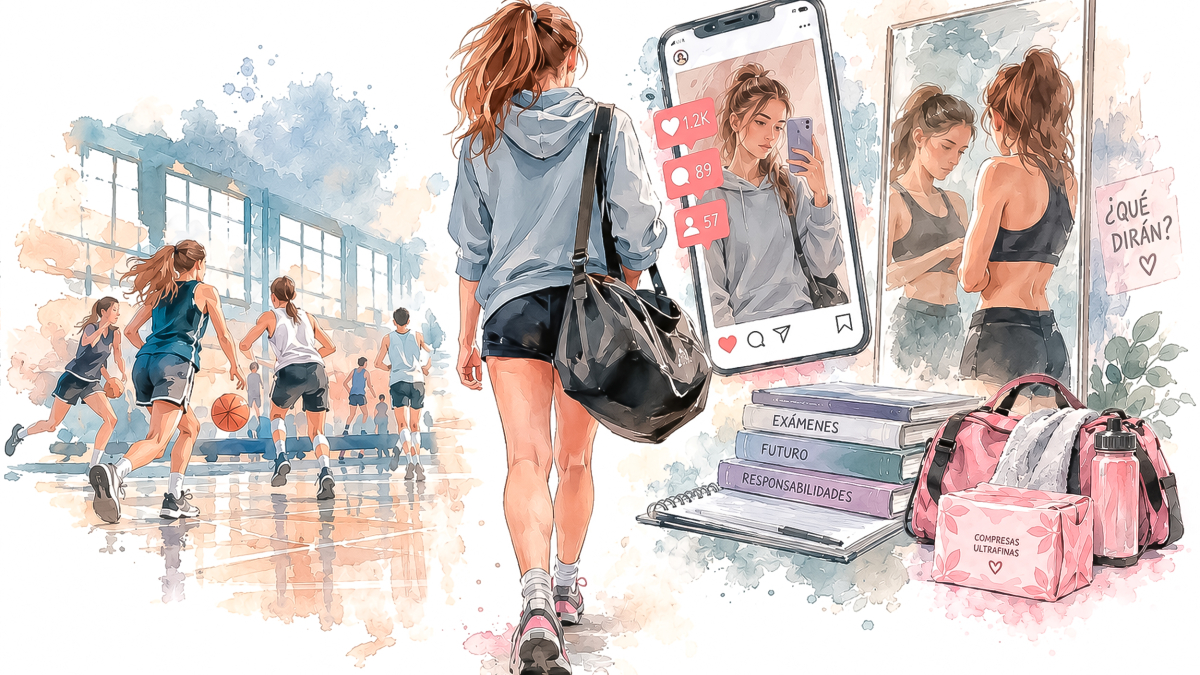
In an increasingly digitalized world, where sedentary lifestyles and screen use have skyrocketed among the adolescent population, experts have focused on a worrying trend: the disengagement of girls from physical activity. While during childhood sports practice is remarkably similar between sexes, upon reaching puberty and adolescence, a drastic drop in female participation is observed. This phenomenon, far from being anecdotal, reveals a sports system with deep cracks that penalize adolescent girls, raising invisible but formidable barriers that boys do not usually encounter. The paradox is clear: many of these young girls wish to remain active, but current circumstances push them to abandon a crucial habit for their physical and mental health.
A Sports Model that Prioritizes Competition and Excludes
Recent studies have released revealing data that highlight this disparity. Up to 7 out of 10 girls express the desire to move more and better, but they encounter a series of obstacles that boys do not experience with the same intensity. One of the expert voices in this analysis, María Martín, points directly to the problem in the offer and the available opportunities. «The offer continues to privilege the best and the masculine,» explains Martín. This orientation translates, especially in adolescence, into a marked focus on competition. While all young people seek to enjoy, have fun, and feel good with physical activity, the predominant model focuses excessively on performance and less on health and overall well-being.
This prioritization of the competitive model has direct consequences. The figures speak for themselves: one 61% of the boys practice a competition-oriented sport weekly, compared to one 36% of the girls. The motivation to compete also shows a significant gap, with one 43% of the boys feeling attracted to it, compared to only one 18% of the girls. This imbalance implies that those adolescent girls who want to practice sports for different reasons —such as socialization, maintaining physical fitness, or improving health— see their options penalized and reduced. Furthermore, at this crucial stage of life, mixed teams usually disappear, and the new teams that are formed are already born with a clear competitive vocation, leaving little room for other motivations. Sport, instead of being an inclusive tool, becomes a filter that excludes a large part of the female population.
Physical and Psychological Barriers: Proximity, Facilities, and Intimidation
Beyond the competitive model, there are other factors that contribute to the sports dropout rate among adolescent girls. During the High School stage, the academic workload increases considerably, demanding more time and dedication to studies. In this context, the availability of local sports options becomes crucial. Girls, however, have fewer options aimed at them close to home. If they have to travel further to practice a physical activity, which implies more time and greater family support for transport, many prioritize studies, sacrificing sport. This reality contrasts with the ease that boys often have in finding more accessible options.
Another fundamental aspect is the type of facilities and the atmosphere within them. Boys mostly occupy collective practice spaces and sports venues, partly because many of these spaces are designed for competition, but also because girls do not feel comfortable there. María Martín has highlighted a particular finding in national studies that does not appear so clearly in other countries: «Girls sometimes talk about intimidation, even fear. They feel expelled, they go to facilities where they do not feel comfortable. Here, barriers such as a lack of safety, embarrassment converge...». This feeling of insecurity is not exclusive to indoor spaces; surveys reveal that a surprising 93% of the women surveyed have felt fear when doing outdoor sports. This reality has driven initiatives like ‘Train Safely‘, a WebAPP developed by the Association for Women in Professional Sport (AMDP) in collaboration with Uriaxait, which uses artificial intelligence to collect and analyze the feelings of insecurity experienced by women in sports facilities. The perception of safety and well-being is, therefore, a fundamental pillar for retaining adolescent girls in sport. Overall well-being, such as that which seeks to promote the transformative change of Laura Escanes, is a key factor for female involvement in physical activity.
Historical Prejudices and the Fight for Normalization
Today's reality also has roots in historical prejudices about femininity and sport, some of which are still perpetuated, albeit in a more subtle way. Two prominent figures in Spanish sport, Teresa Portela, Olympic runner-up in K1 200, and Lucía Martín-Portugués, have shared their experiences. Portela recalls the beginnings of her career years ago 30 anys, when «it was not so normal for girls to do sports.» She explains a particular case in canoeing, a discipline that requires strength and develops muscles, where some mothers advised their daughters against continuing because it did not fit certain standards of femininity. Although Portela believes that this mindset has changed, the repercussions of these stereotypes persist.
Similarly, Lucía Martín-Portugués recounted in an interview that during her adolescence it was «terrible» to have a strong body, with defined abs and legs, due to social pressure and the beauty ideals of the time. These experiences of elite athletes illustrate how social expectations of the female body can act as an additional barrier, even for those with exceptional talent. Society has advanced, but the full normalization of women in any sports discipline, free of judgment and stereotypes, remains a goal. The visibility and recognition of women's sports, such as what is attempted to be given in events like La Nit de l’Esport, are important steps to change this perception.
The persistence of these barriers, from the configuration of the sports offer to the perception of safety in spaces and social prejudices, makes the «great resignation» of adolescent girls from sports an undeniable reality. Addressing this issue requires a profound review of the sports system, prioritizing inclusion, diversity of motivations, and the creation of safe and welcoming environments for all young women.

