


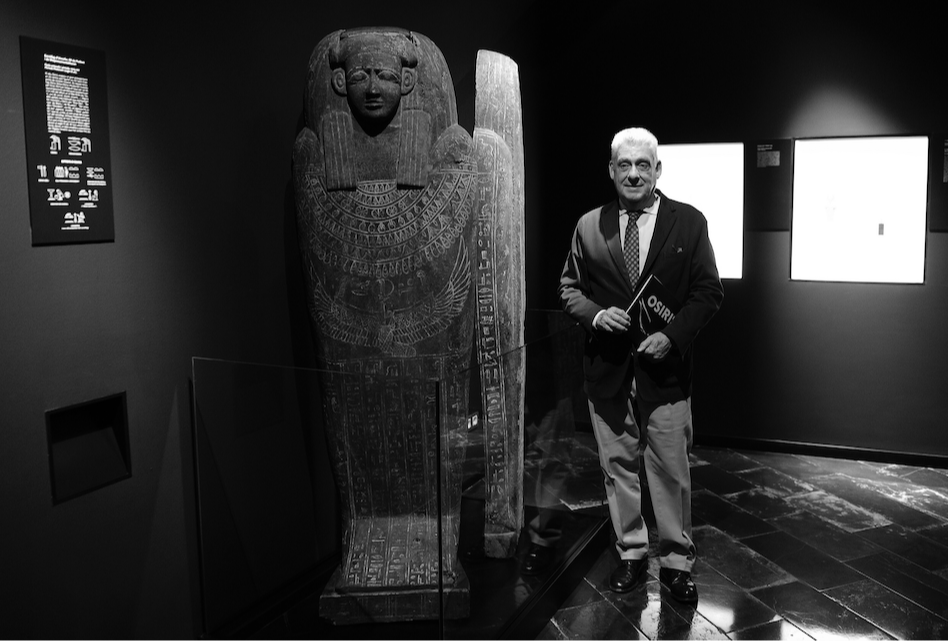
The Royal Catalan Academy of Fine Arts of Sant Jordi has taken another step in its commitment to the recognition of talent and social involvement in the world of culture. In a solemn ceremony held this past September 16 a la Casa Llotja de Mar, the historic assembly hall that hosts the institution, the hotelier and patron Jordi Clos was invested as honorary academician. An appointment that is not a mere protocol gesture, but rather recognizes a life and professional career that has turned culture, heritage, and knowledge into the backbone of his public and private action.
The event, which brought together personalities from Barcelona's institutional, business, and cultural worlds, served to highlight a way of understanding culture that goes far beyond passive contemplation. The figure of Clos, president of the Barcelona Hotel Association, is projected as that of an active agent, capable of building bridges between the private sector and public institutions, and also as that of a citizen committed to the memory and dissemination of historical heritage. His induction into the Academy is not a point of arrival, but rather a platform to continue promoting a vision of culture as a driver of social transformation and international projection.
A patron of archaeological heritage with a vision for the country
If there is one area where Jordi Clos's work has left an unmistakable mark, it is in the preservation and dissemination of archaeological heritage. In the year 1993, at a time when Barcelona society was beginning to look towards its historical roots with a new perspective, Clos promoted the creation of the Clos Archaeological Foundation i del Museu Egipci de Barcelona. What began as a private collection, forged thanks to his passion for ancient Egypt, has consolidated over the years as one of the reference centers in Spain for the study and dissemination of pharaonic civilization.
His vision was not limited to building a cultural facility. From the very beginning, Clos understood that a 21st-century museum had to be a living space, capable of connecting with all audiences. Temporary exhibitions, lectures, educational workshops, and specialized publications have been a constant in his management, turning the museum into a true laboratory of ideas. This work has decisively contributed to placing Barcelona on the map of major European cities committed to the dissemination of ancient heritage, an effort that has also had a notable impact on the cultural revitalization of the neighborhoods surrounding the institution.
In this context of defending roots and identity, it must be emphasized that Catalan culture is experiencing a moment of reflection on its future, with initiatives demanding a greater popular presence in institutions. The same desire to bring culture to everyone, without barriers or exclusions, is what drives projects like the one promoted by the Coordinadora de Colles Castelleres, which asks Parliament for popular culture to have its own voice in the new law on cultural rights. A demand that connects directly with Clos's idea that heritage and knowledge are common goods that must be defended and transmitted.
Clos's gratitude and his renewed commitment to memory
During his acceptance speech, Jordi Clos wanted to show his most sincere gratitude to the Academy for the distinction, but went beyond simple protocol gratitude. Clos championed the role of culture as a driver of knowledge and social cohesion, and assured that this institutional recognition represents, above all, a renewed responsibility to continue working in defense of historical heritage. In his words, culture cannot be a secondary or accessory area, but must become a strategic priority for Barcelona and Catalonia, especially in a globalized world where identity and memory are more necessary than ever.
This year's appointment also comes at a significant moment for the sector. On one hand, the city is preparing for major cultural events that will once again put Barcelona in the international spotlight, such as the celebration of La Mercè, where emblematic spaces like Park Güell become stages for artistic creation. In fact, this year's programming has been specially designed to reinforce the link between culture and territory, a line that connects with Clos's philosophy: the right to culture cannot depend on the postal code where one is born. A maxim that is also defended by the project of the theater-truck that brings the performing arts to the towns of Catalonia and which perfectly illustrates this desire for accessibility.
Clos's patronage work, however, has not been limited to the archaeological field. His support for research projects, exhibition production, and educational initiatives has been constant for decades. A way of understanding patronage as a tool to generate opportunities and to open paths for young researchers, who often see their future limited by a lack of resources. This philosophy, which emphasizes the social function of collecting and sponsorship, has been one of the keys that the Academy has taken into account when distinguishing him.
With the incorporation of Jordi Clos, the Royal Catalan Academy of Fine Arts of Sant Jordi not only expands its roster of academics, but also reaffirms its desire to open up to society. A historical institution that looks to the future, that wants to recognize work well done, and that understands that the preservation of legacy is not a look backward, but a way to build a better tomorrow. Clos's commitment, now as an honorary academician, remains linked to that of the institution itself, in an alliance that promises to bear much fruit in the coming years.

